
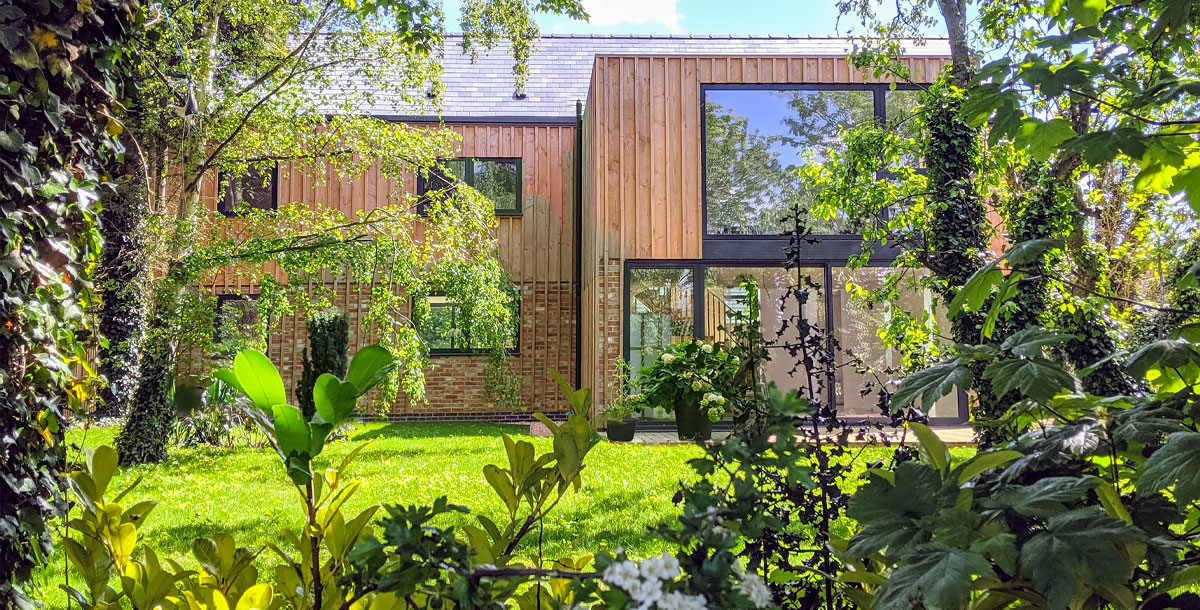
The promise and perils of SIP builds
They promise quicker construction and a route into self-building that doesn’t start with you sitting staring at a blank sheet of paper. But what are the need-to-knows before building a home with Structural Insulated Panels (SIPs)?
It’s no secret that rising house prices and stagnating supply has meant that a growing amount of people are finding themselves priced out of owning their dream home.
Enter SIP builds and prefabricated homes – a route more and more people are exploring to help make their money go further.
But are SIP homes all they’re cracked up to be?
We’ve done some digging into whether the process really can deliver a cheaper, more efficient route to your ideal home.
SIP builds, in a nutshell
Structural insulated panels (SIPs) are factory-made sandwich panels, usually with a rigid foam core glued between two structural facings.
This means the panels act as both structure and insulation.
SIPs can be used for walls, roofs, and even floors, forming the main structural shell of a house.
SIP builds are a construction system, rather than a full “kit house” in themselves, and are often used alongside standardised house designs supplied by a panel manufacturer.
Instead of an architect designing every single detail from scratch and a builder constructing it on site, many SIP suppliers now offer pre-engineered homes that arrive with buyers as a series of numbered panels, ready to assemble.
The growing popularity of SIP builds
SIP built homes have certainly moved into the limelight in recent years, and with good reason.
Many people are drawn to their affordability and predictability.
Upfront package pricing from SIP suppliers can feel less open-ended than a traditional architect and builder route, where design hours and on-site labour can quickly spiral.
The speed at which SIP builds can go up can also be a big part of their appeal, as it cuts the period you’re paying rent and a mortgage, or a bridging loan, at the same time.
SIP builds also have the potential for lower energy and running costs – appealing to both the climate conscious and budget-minded.
The potential for location flexibility is another draw for many buyers.
Off-site manufacture means much of the work can happen in a factory, which can be attractive compared with weeks of open-air construction.
SIP builds can be cheaper and faster than a fully bespoke architect-designed one-off home, too.
However, they may not necessarily cost less money than the absolute cheapest conventional build.
How SIP projects work

Image credit: Kelly Sikkema on Unsplash
The process behind prefabricated homes usually begins with choosing a SIP supplier or package company.
Many of these offer a catalogue of designs for you to select from, as well as some options that you can tweak and personalise to your taste.
Next is the design stage. You may still opt for the help of an independent architect here, for things like site planning, internal layout and aesthetics.
However, the in-house designer and engineer from your chosen SIP supplier or package company could be enough here, depending on exactly what you’re looking for.
The next step is engineering and getting approvals.
As with any build, SIP designs must be signed off structurally, since things like the way that the build interacts with local building regulations must be considered.
After this, the panels for your chosen design can be sent for off-site manufacture.
At this point, on-site work can begin.
You’ll need to either hire a local contractor to handle the groundworks, or if you’re more hands-on, follow guidance from your SIP supplier and do more of this yourself before a specialist SIP erection crew arrives.
SIP timelines
Here’s a closer look at what you could be looking at timeline-wise for a SIP build in the UK:
- Planning and design
Finding a plot, securing planning permission, and completing detailed design and building regulations can take 6-12 months. SIPs don’t meaningfully compress this stage (the time savings only really kick in once you’re ready to build). - Off-site SIP design and manufacture
Once the design is signed off, UK suppliers can quote around 4-8 weeks from approval to delivery of the SIP kit, depending on factory lead times and how busy they are. - Groundworks
Laying the foundations and completing drainage and other groundworks can take about 2-4 weeks, depending on variable factors like soil conditions, access and weather. - Assembling the shell
This is the headline advantage of a SIP build. Some UK SIP suppliers state that a full shell and roof can be erected in about 5-7 days, while others give a range of 10-15 working days depending on size and complexity. - Weatherproofing
Once the SIP shell is up, the building can be made weatherproof very quickly (adding roof coverings, windows, and doors). This can typically take around 5-6 weeks. - Finishing touches
This stage varies depending on things like specification and how organised your builder is, but you might expect roughly 8-12 weeks for internal fit-out and finishing.
Altogether, a typical SIP home might be finished on site in about 4-6 months, whereas an equivalent traditional masonry or timber build is more like 6-9 months.
So, SIPs can cut the on-site build time by roughly a third, though planning and design take just as long for both routes.
The pros and cons of SIP builds

Image credit: Billy Freeman on Unsplash
As with any project, SIP builds come with their own promises and perils.
We’ve drawn up a list of some of the potentials that might be encountered:
The pros
- Speed and predictability: The structural insulated panels arrive pre-cut and labelled, making build time much shorter than if it were to go up piece by piece on site. This can remove a lot of stress around weather risk and seasonal issues.
- Energy performance: Being highly insulated with low air leakage means SIP builds have the potential for very low heating bills – when combined with good ventilation.
- Labour savings: Prefabricated homes have less need for highly skilled workers and carpenters on-site, since more of the precision work is done when the panels are constructed.
- Between bespoke and off-the-peg: For many people, a standardised SIP design offers more choice than a typical developer house, but with lower risk and cost than a fully bespoke one. For example, some owners bring in an architect for a small amount of targeted work at the end, such as façade design and internal layout.
- Environmental benefits: SIP builds tend to have lower operational energy use, less site waste, and the potential to use timber-based skins from managed forests, depending on your supplier.
The cons
- Moisture and mould: The main structural skins are often oriented strand board or similar. If water seeps into the panel and can’t dry it can rot, grow mould and ultimately compromise the build’s structure. Joints and around roofs and windows are weak points, so detailing and airtightness are critical. It’s also worth keeping in mind that some land plots, such as flood-prone and very damp areas, are generally considered unsuitable for SIPs.
- Ventilation and indoor air quality: The same airtightness that improves energy performance means you can’t rely on “leaky” natural ventilation. Without planned ventilation in a SIP build, you can end up with condensation, humidity and air quality issues.
- Hidden costs: Material costs can be higher than conventional timber framing, with savings coming mainly from the speed and reduced labour needed for SIP construction. Overall, cost competitiveness depends heavily on local labour and how optimised your SIP design is. Some lenders and insurers can also be cautious with non-standard construction methods, so it’s worth checking early what documentation they’ll require for a SIP build.
- Site constraints: The large, factory-made panels of SIP builds can require good access for delivery, so tight urban sites or very rough access tracks may add cost or even rule them out entirely.
Is a SIP build for you?
Image credit: Clay Banks on Unsplash
When deciding whether a SIP home is right for you, you should be honest with yourself about your project. Start with your site – is it straightforward to access with lorries, free from flood risk, and structurally suited to panellised construction methods?
Then think about your priorities.
If what really appeals is low running costs and a fast, predictable shell build, a SIP home could be a good fit.
If you are drawn to more sculptural forms and the idea of being able to make alterations as you go, you may find the rigidity of a SIP structure more of a constraint than a comfort.
A SIP project offers the biggest rewards to those who are happy to make big decisions early on and commit to a design.
Finally, think hard about the question of who will actually build it.
A contractor or company with a proven track record in SIP builds is non-negotiable, as this likely isn’t the kind of project where general building experience will be enough on its own.
SIPs can be an efficient and powerful tool when used in the right way, but they’re not a magic ‘quick fix’ for every build.

