Can you paint over wallpaper?
This often seems like a quicker option when redecorating, but is it the best thing long term? We spoke to the experts...
Painting over wallpaper is a controversial act. Some people see it as cheating and it isn’t recommended, but others think it’s ok as it can save both time and money.
Stripping wallpaper away can be time consuming, but if you’re looking for a shiny new paint finish – it could be the better option for a professional finish.
We spoke to some experts about what they really think about painting over wallpaper. Is it a downright no, or are there circumstances where it’s ok if it saves time and money?
Can you ever paint over wallpaper?
Robert Aumann, luxury real estate adviser and interior design expert at luxurysocialrealty.com believes it is feasible.
“When executed by knowledgeable professionals, it can achieve a seamless look. They key is to look at the wallpaper and assess it.
If it’s securely attached to the surface, not peeling at the corners and with no bubbles or creases, you’ve got a solid base.
“Stripping the wallpaper can damage the underlying plaster or speciality drywall in many luxury homes.
You don’t want to tear into high-end finishes, risk getting off track and lose the plot.”
However, if you’re wanting a supreme finish it might be better to take your time and get stripping, explains Jimmy Englezos, senior brand manager at Ronseal.
“If you’re wanting a perfect finish, it is often better to strip and paint the wall from scratch. It is also advised to remove the wallpaper if either its condition is damaged, or peeling, or its appearance is particularly bold.”
When can you paint over wallpaper?
Robert explains: “Painting over wallpaper is advantageous if you need a quick project turnaround or the walls conceal finishes that could be damaged during wallpaper removal.
“A few coats of paint over the wallpaper can actually look quite stunning and give the room a special feel that plain drywall just doesn’t have.
“I have seen projects in expensive neighbourhoods use this approach when clients want a completely new look.”
Kunal Trehan, interior designer and founder of Touched Interiors adds: “When the wallpaper is firmly bonded and smooth, and is well-adhered with no peeling seams, bubbles or loose edges, it can act as a solid base layer.
Some older papers are so stubborn that removing them does more damage than good, in that situation – painting is the sensible choice.
“It’s also a good idea if you’re working with delicate plaster. Many Victorian and Georgian homes hide fragile plaster behind decorative paper.
“Stripping it can lead to crumbling surfaces and unexpected repair costs. A coat of primer and paint keeps everything intact.
“If you’ve inherited a busy print but the room needs a quick transformation, painting over it would be the quickest route to a calm, contemporary backdrop.”
When shouldn’t you paint over wallpaper?
It isn’t always the right thing to do though, there are moments when painting over wallpaper becomes a false economy.
Kunal explains: “For example, if the wallpaper is textured or damaged, as raised patterns, tears, bubbling or lifting seams will all show through paint – often more prominently. In these cases, stripping and skimming would be the only way to get a flawless finish.
“It’s also the case if the wallpaper is vinyl or has a heavy sheen.
“These surfaces repel moisture and can make it difficult for paint and primer to bond properly. Even if it looks good on day one, adhesion issues may show up quickly.
“Additionally, if there are any signs of damp or mould.
“Painting over structural or moisture issues simply masks the problem, trapping vulnerabilities behind layers of paint. Always treat the cause first.
“Finally, if you’re planning a long-term colour scheme.
“For a forever home, or a major redesign, stripping everything back gives you the cleanest foundation and ensures future updates are easier.”
Which paint can you use on wallpaper?
If you’ve decide to go ahead and paint over wallpaper, you can choose particular paint to coat the wallpaper sufficiently.
Jimmy shares: “You don’t need to use a special paint for wallpaper as any good quality wall paint will cover the wallpaper and leave you with an even finish.
“Multi-surface paints such as Ronseal’s One Coat Everywhere can be useful if you’re planning to colour-drench the room in a single colour tone.
“You don’t always need to use a primer when you’re painting wallpaper except for covering a particularly bold print, making a drastic colour change, or painting vinyl wallpaper.”
How to paint over wallpaper
Jimmy shares a step-by-step guide to painting over wallpaper.
What you’ll need
- Wall paint
- Paintbrush
- Paint roller
- Paint tray
- Step ladder
- Dust sheets
- Sugar soap
Step-by-step guide to painting over wallpaper
- Prepare the room
Move out as much furniture as possible and cover any remaining items with dust sheets. Apply painter’s tape around the wall’s edges. - Prepare the wall
Make sure you thoroughly clean the wallpaper to remove any dirt or dust using some sugar soap. Make sure you’re not soaking the surface, use a sponge to apply the cleaning product, and gently wipe it over the wallpaper. - Stir the paint
Before applying the paint, make sure to give it a thorough stir to ensure colour consistency. If using more than one tin of the same colour, mix them together. - Apply the paint
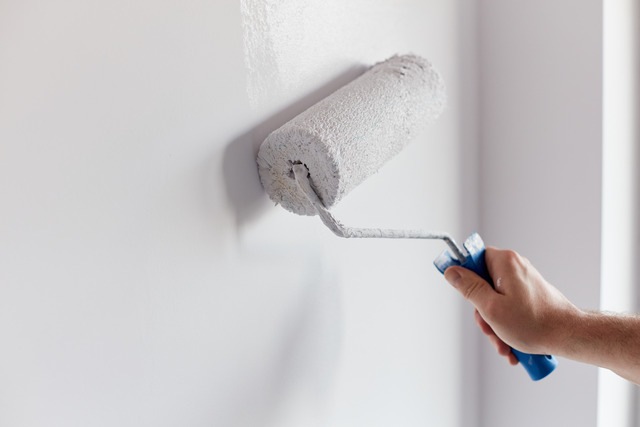
Using a paint roller, apply the paint to the wallpaper surface ensuring an even coat. - Leave to dry
Leave this to dry for at least one hour. If a second coat is needed, wait at least 2-4 hours before applying another coat. - Tidy up
Once the paint is completely dry to the touch, remove any dust sheets and clean any brushes and rollers using warm, soapy water.