The Cabins in the Pines
A careful blend of nature and know how, the cabins of Trekronå transport guests to the heart of the forest
The purpose of the humble pinecone is to protect the seeds within.
Safely clasped behind tightly closed scales, they weather out the winter winds and cold, to be released in warmer months.
Floating in the forest canopy of rocky Rogoland, the cabins of Trekronå present a futuristic take on this protective function, offering guests a place of sanctuary from which to explore the rugged coastline.
That natural beauty provided the catalyst for the cabins’ creation.
“We had been walking in this area for decades,” explains owner, Henrik Stokkeland, “and always had an idea to do something here. It’s so peaceful.”
The serenity is greatly enhanced by the cabins being set within a 450,000 m2 / 110-acre estate that has been in Henrik’s family for three generations, retaining its untamed character under their careful stewardship.
But it was something micro, not macro that provided the final impetus to build.
Henrik and his social worker wife, Lene, witnessed the impact of the Covid pandemic on their local community, and wondered if the healing power of nature might be harnessed to help people recover from that collective trauma.
“Our first thoughts about treetop cabins began during the lockdown in Spring 2020,” recalls Henrik.
“Could we do something special for the people around us, who needed good and positive experiences?”
Tree houses normally impose themselves upon their arboreal hosts, but Henrik and Lene wanted the lightest of touches.
Making a minimal impact on forest and floor was very much a family matter.
“My grandfather planted the whole property with trees”, Henrik grins.
“We only felled two during this project, one of which was already in Tree Heaven!”
The pines themselves provided the core design idea.
“The pinecone was part of the inspiration for me,” explains architect, Manuela Hardy, who worked in partnership with Henrik.
“I also wanted to build on my childhood dreams of cabins in the woods.
“Henrik gave me artistic freedom, but was also clear about what he wanted. We share the same fascination for playful design.”
The result is a playful but sophisticated piece of geometry, whose abstract forms are still at home in the natural setting.
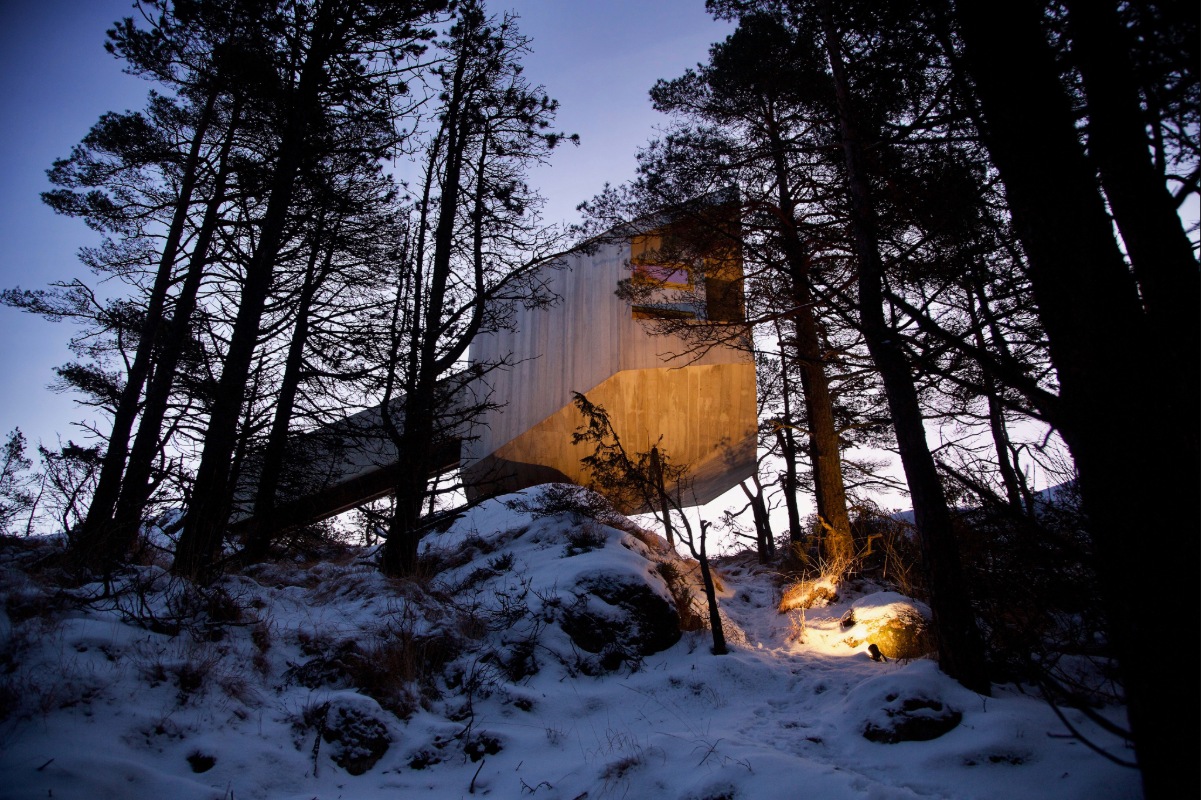
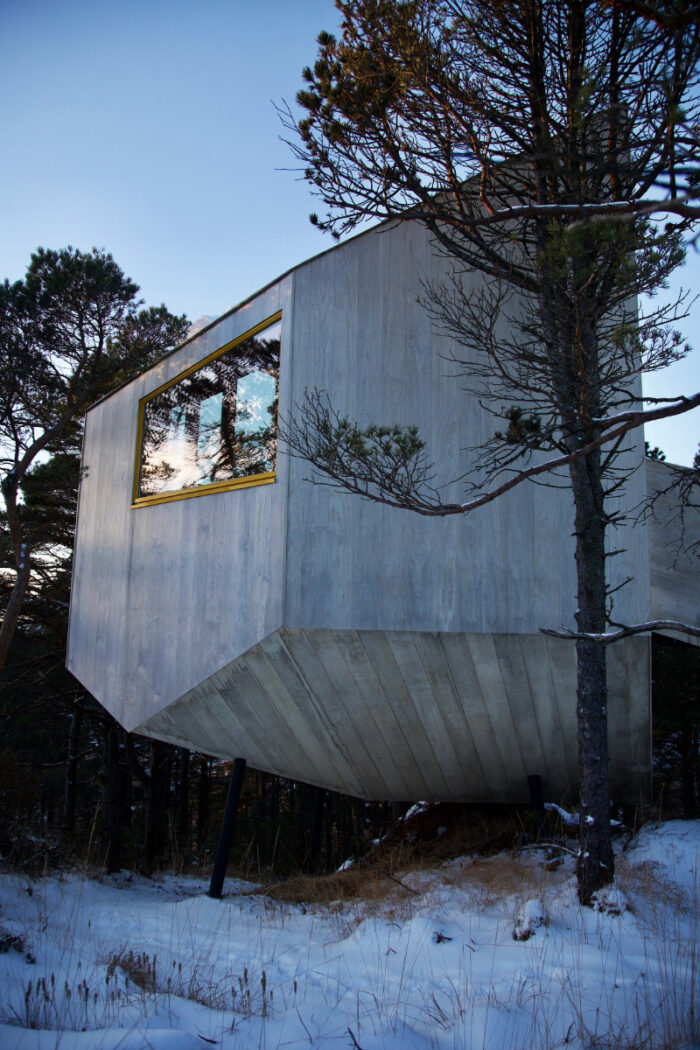
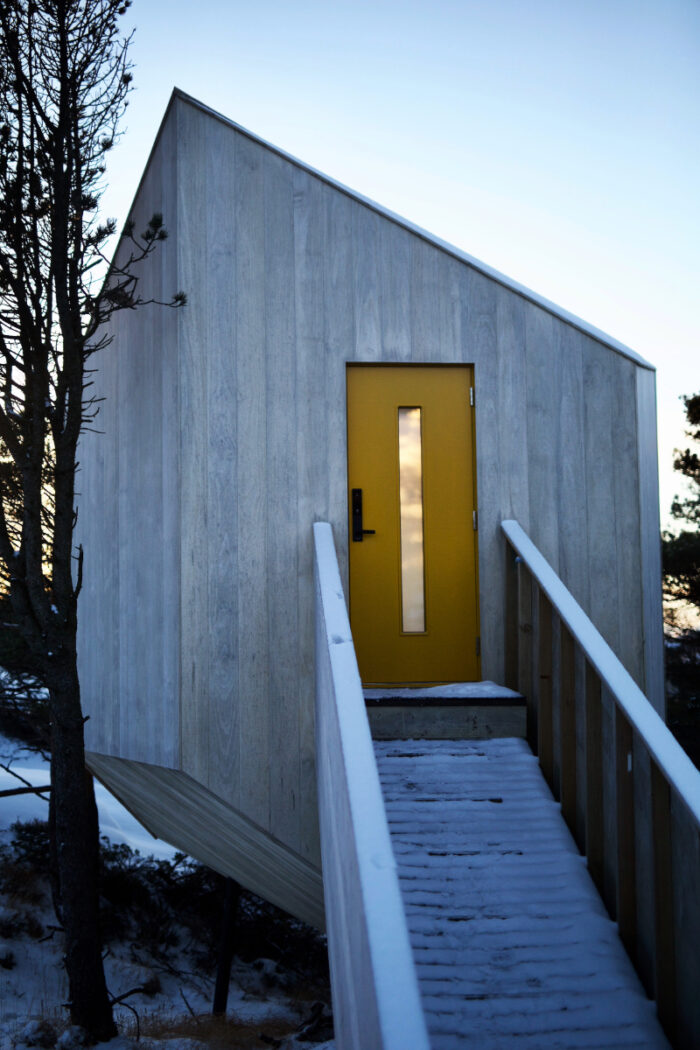
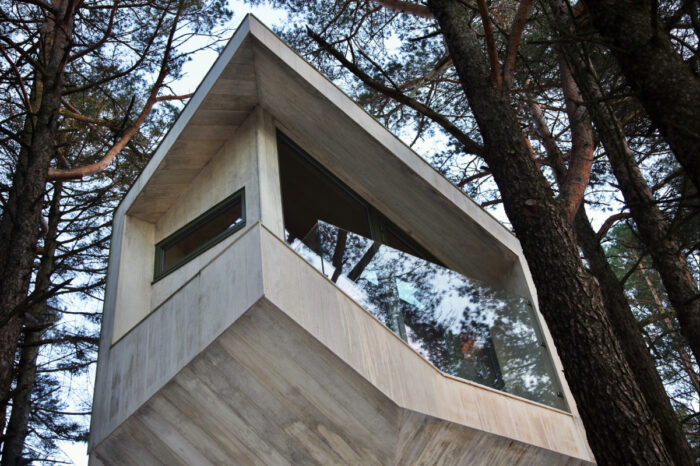
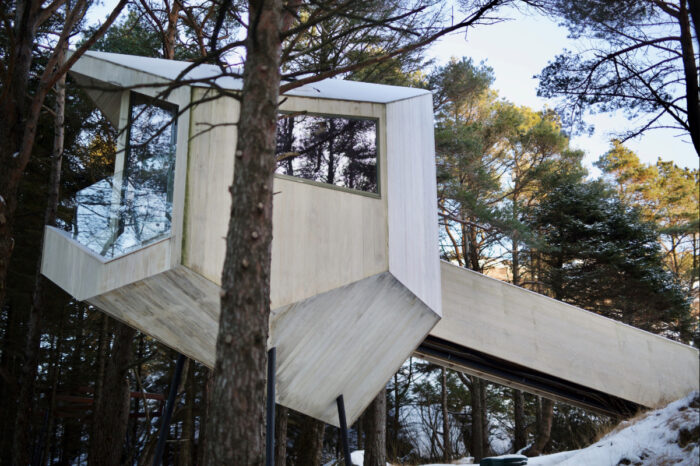
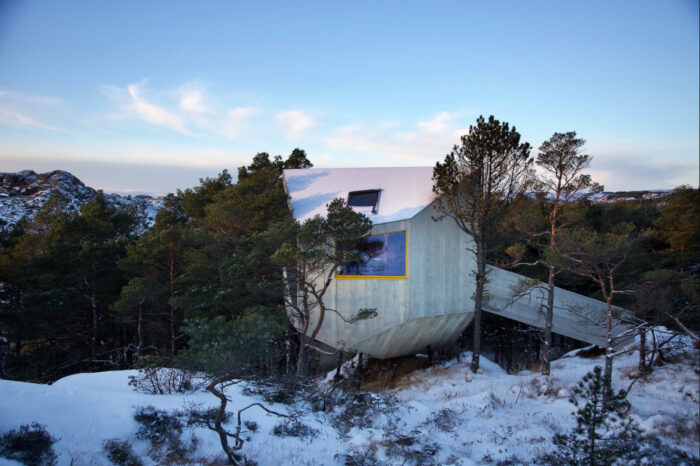
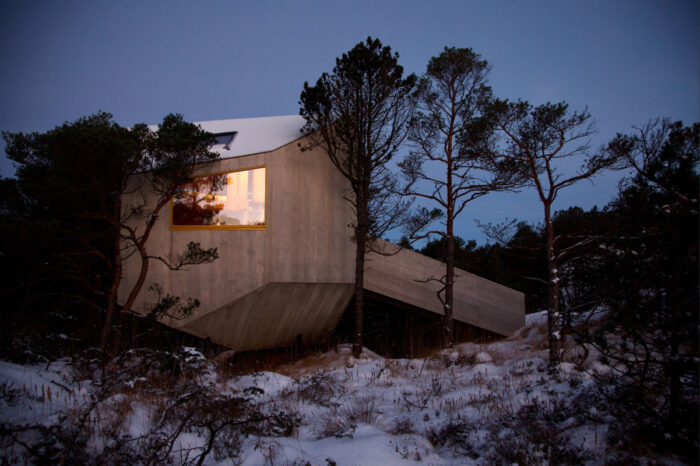
Two pale grey cabins, one accented in yellow, one in green, hover among the trees, seemingly suspended in mid-air, like tumbling boulders frozen in motion.
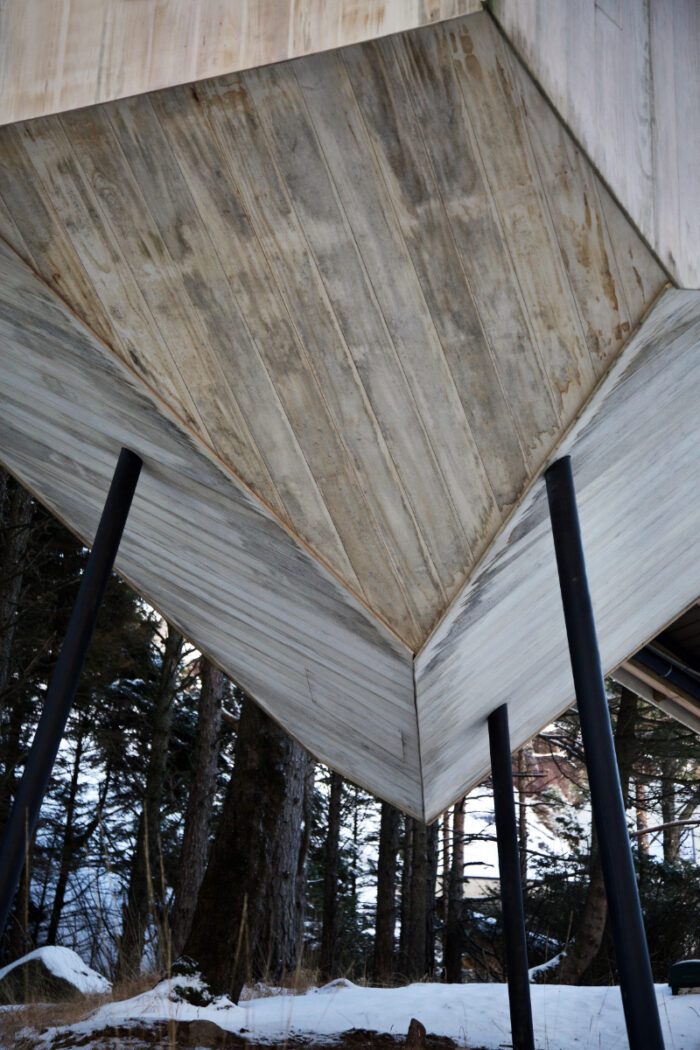
Their weightless appearance is thanks to the tracery of black steel legs that blend with the dark, straight lines of the surrounding pines till they are almost invisible.
Similarly hidden from sight are the hexagonal steel frames that provide the solid base plates for the cabins’ structure, anchoring all the frames and facets of the walls.
Construction photos of these bare rings of steel, hovering on their tripod legs, and provide a visual parallel with the project’s chosen name.
‘Trekronå’ translates as ‘tree crown’: the botanical term for the combined elements of a tree’s canopy that radiate out from its trunk.
A trained carpenter himself, Henrik took a very active role in the construction.
His and Lene’s concern for the community provided the project motivation, but it was that same community that helped get the cabins over the line.
“I was hands-on with basically everything,” he smiles, “and we had a lot of good people around us!
“When I harmed my foot and snapped my Achilles tendon, they were all glad to help as volunteers.”
Though cranes and diggers were required during construction, all vehicular access was removed once the build was complete, leaving only footpaths and narrow boardwalks.
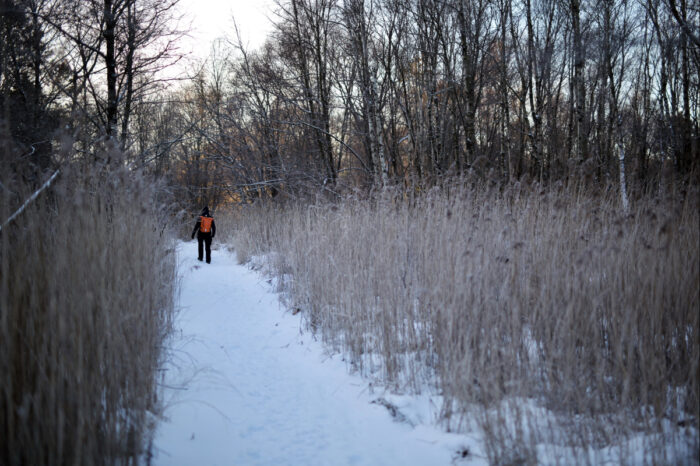
Guests get to enjoy a greater sense of splendid isolation by approaching on foot down snow-covered forest trails, to discover these little gems, hidden in the trees.
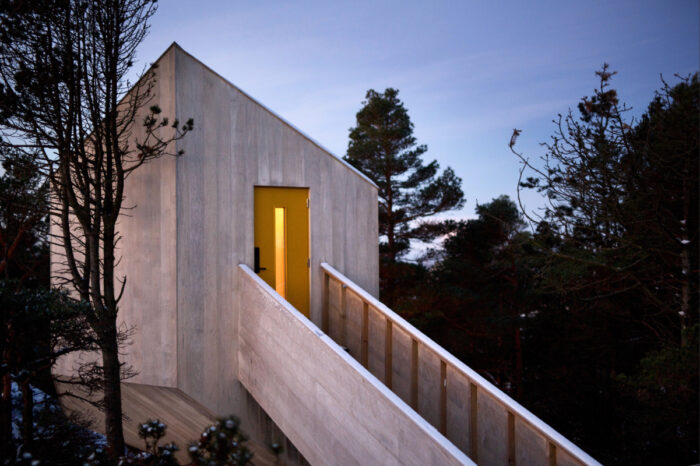
Boarding these land-locked ships up a sloping access ramp feels like embarking on a new adventure.
Though fully serviced, the mundane essentials of power and waste pipes are not allowed to impinge on the purity of the form.
“All pipes and wires are placed under the ramp” explains Manuela.
“The steel legs serve only for support, while the bottom of the ‘hull’ serves as the technical space.”
The timber framing extends above and below the steel base plates, to provide the ‘rib cages’ over which the external cladding can be applied.
The team selected a specially treated pine-based product called Accoya, that is both highly stable and rot-resistant, and quickly weathered from cedar brown to pale silver-grey.
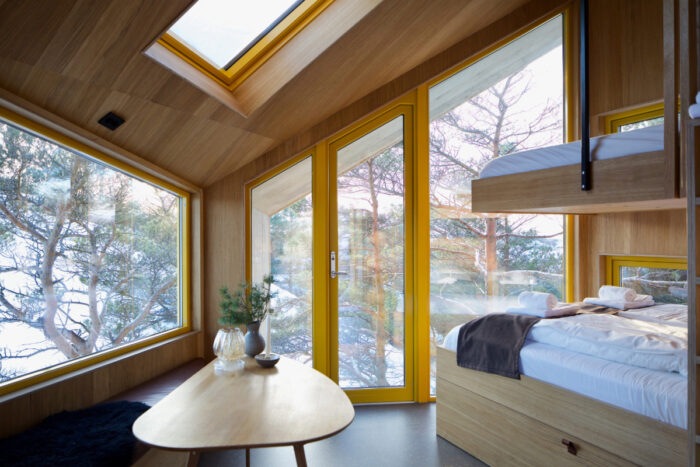
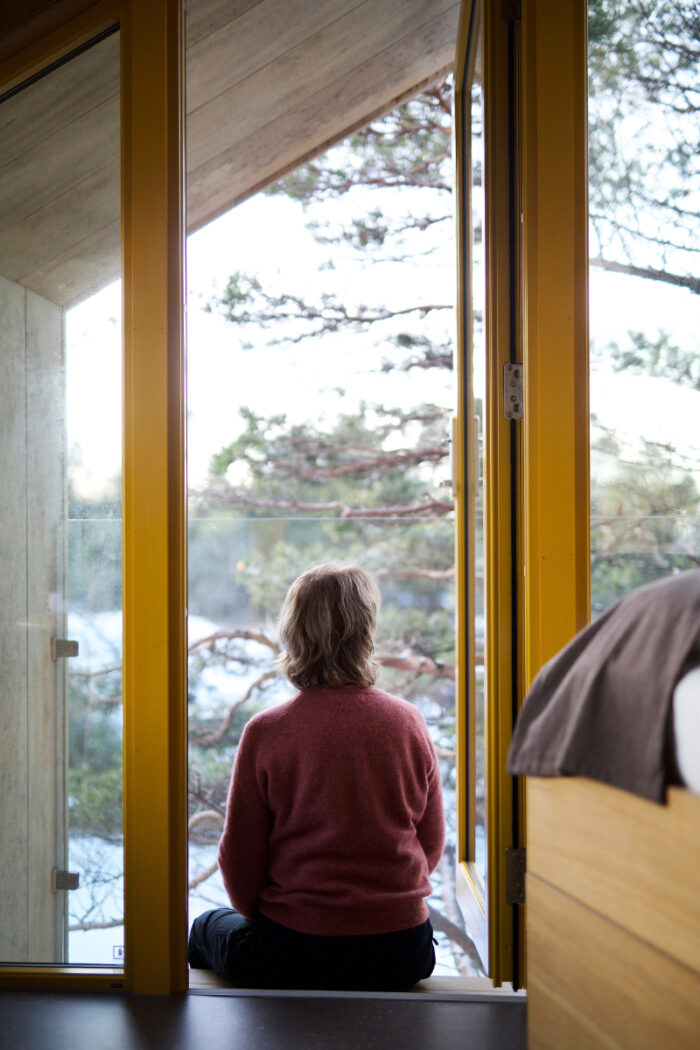
The irregular shapes of the yellow and green window frames are laid flush with the cladding surface, as though scales have been prised off these immense pines cones to let the light filter in.
The complexity of the construction becomes apparent when the cabins are viewed directly overhead, with their irregular hulls hovering on stilts, like ships propped up in dry dock.
“The builder scratched his head a bit to get all the angles to meet!” recalls Manuela.
‘The cabins were modeled in Archicad, i.e. drawn in 3D using Building information Modeling (BIM) and then extracted in 2D to create working drawings.”
Modern technology played its part, but the sheer traditional craftsmanship on display is clear to see, most noticeably in the highly refined interior.
“I got to design all the locally built furniture, which was satisfying but also challenging”, recalls Manuela.
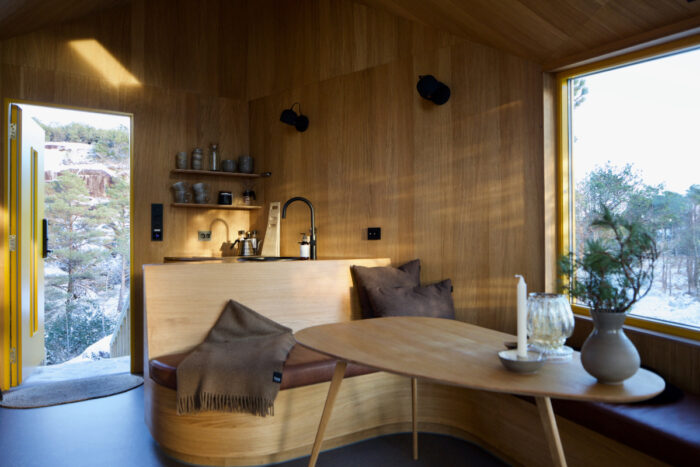
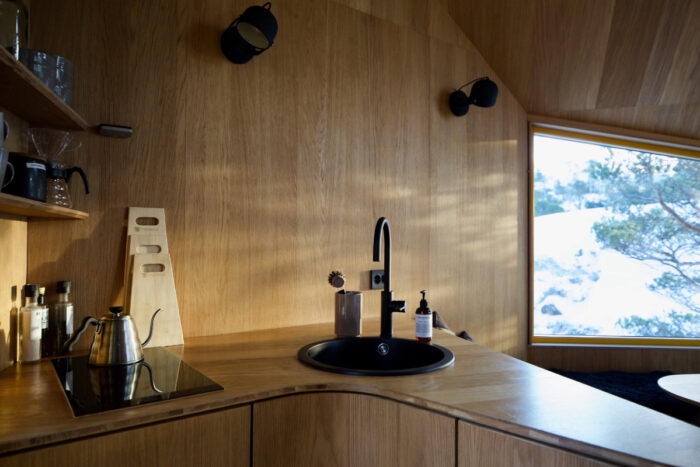
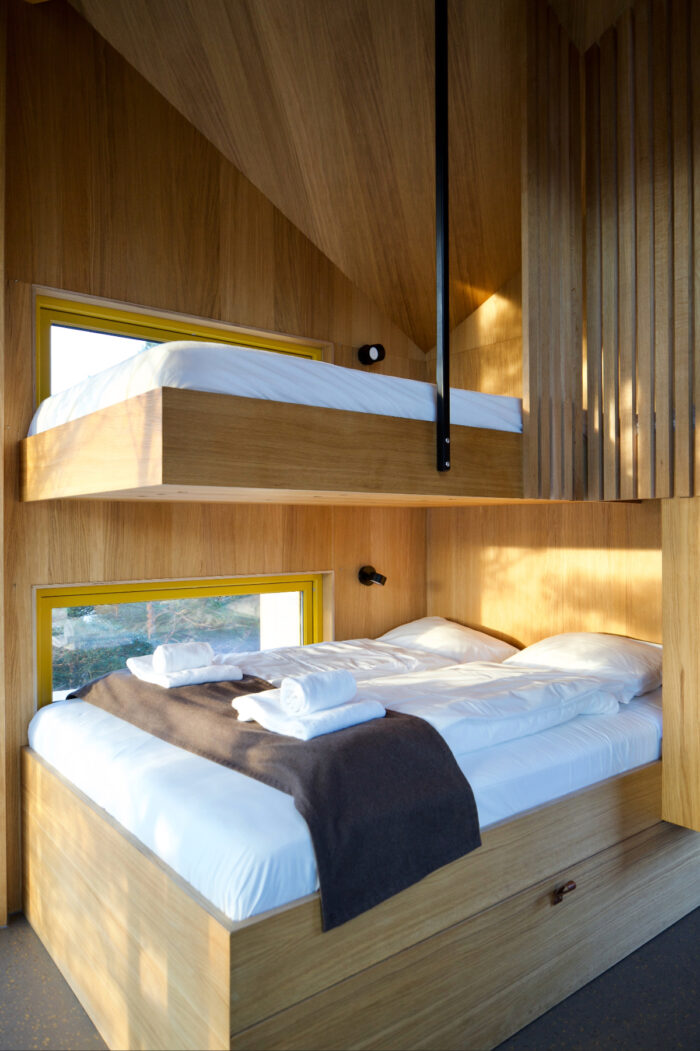
“All the living functions were to be covered in just over 15 sq/m (161 sq/ft), including 5 sleeping places!”
The facilities include a shower room, eating area and sleeping berths, with pullout beds increasing capacity.
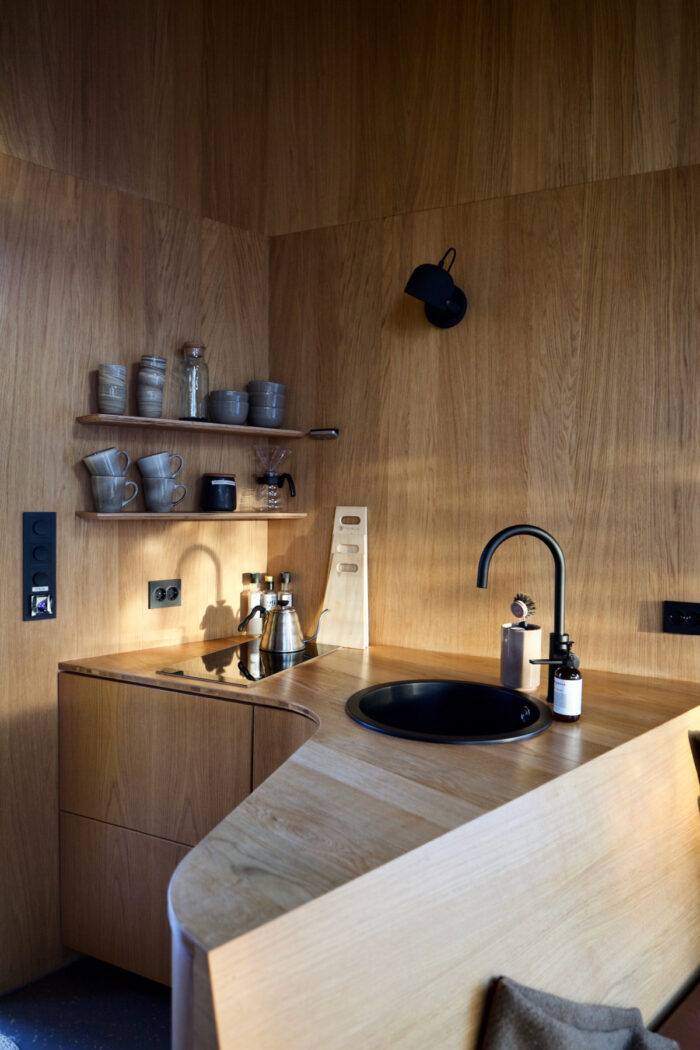
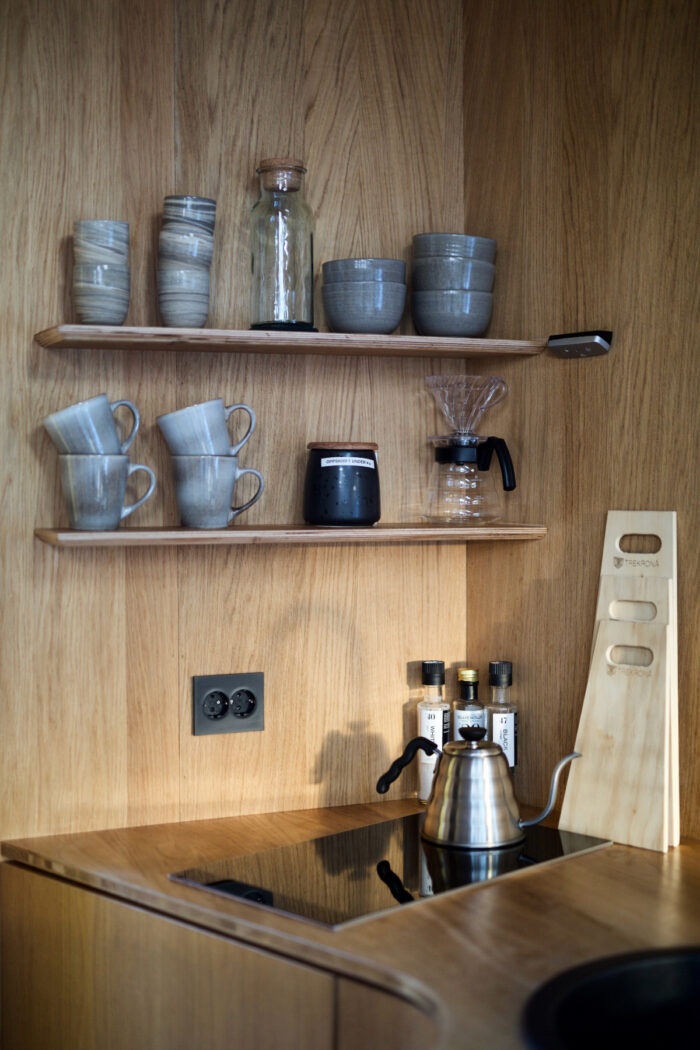
Constructed by the craftsmen of Sigurd Lende AG, the restricted palette of natural materials lends a calm simplicity to tiny living space, with the plain, varnished oak and brown leather upholstery of the bespoke beds and cabinetry.
The stylish, sweeping counter of the compact kitchen hints at Manuela’s admiration for the work of Danish design legend, Arne Jacobsen.
Perfected polished, these little gems are destined to be a limited edition of two.
“We’re not planning any more, as we want them be exclusive,” explains Henrik.
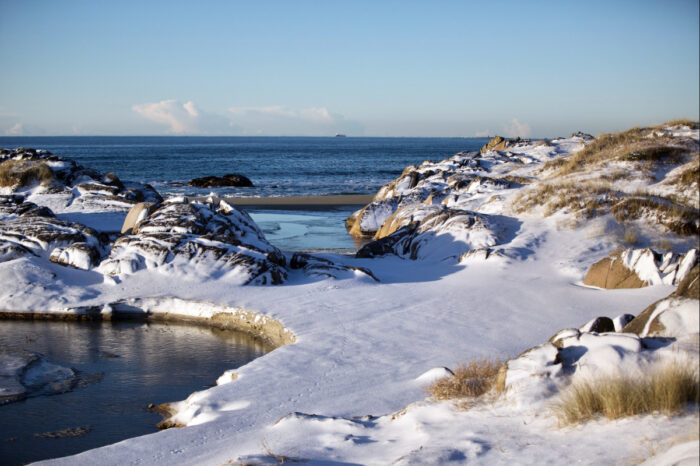
The majestic power and natural beauty of the Norwegian coast line may draw guests to this place, but the cabins of Trekronå could well be the jewels in the crown.
Architect: Manuela Hardy – www.mh-arkitektur.no
Constructed: November 2020 to December 2021 (First cabin)
Owners: Henrik Stokkeland & Lene Mellemstrand Stokkeland – www.trekronaa.no
Photographer: Lise Bjelland / A Design Features
Text: Paul Cattermole / A Design Features